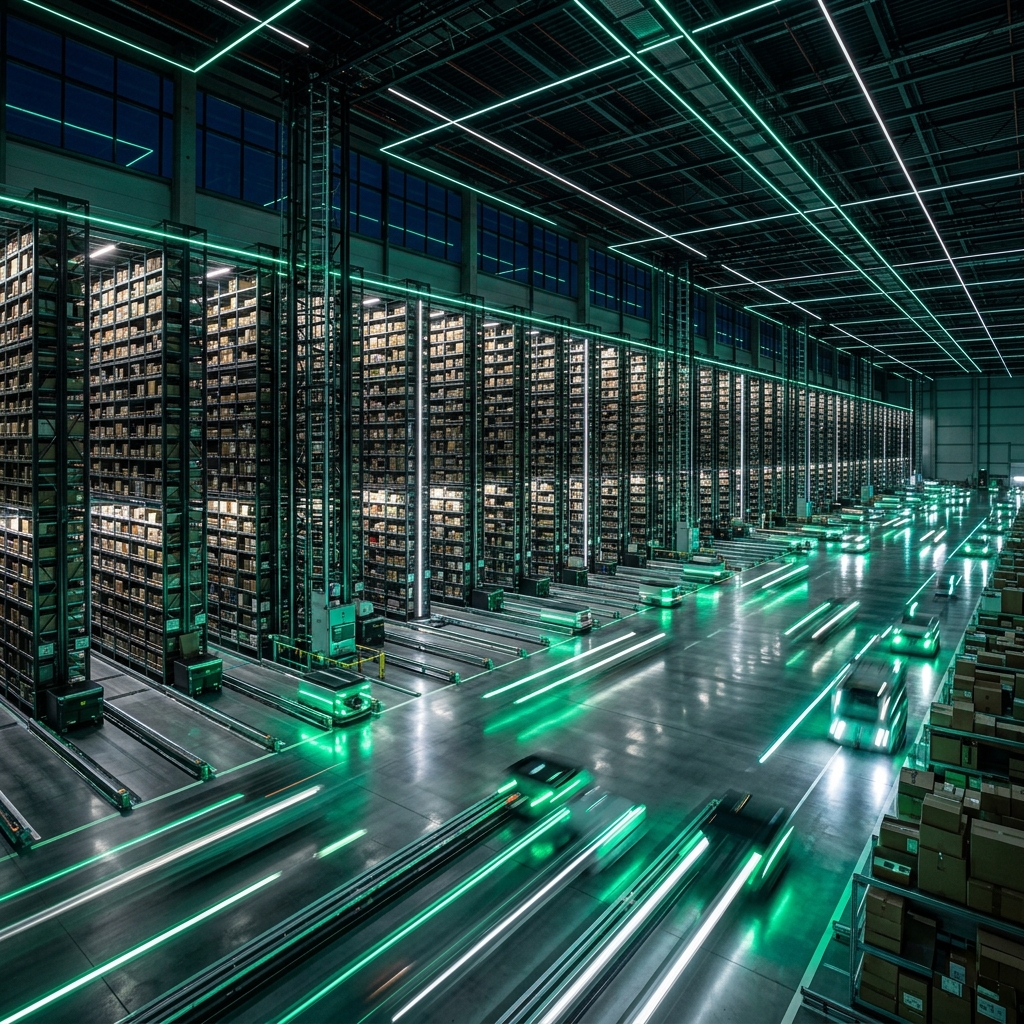
Logistics & Warehouse Safety
Active protection for high-velocity warehouses and distribution centers. DHI runs on your existing cameras to prevent forklift-pedestrian collisions, catch warehouse fire and smoke early, verify PPE compliance, and index every near-miss, all on-premises with no human watching the wall of monitors.
Deployment Context
Logistics & Warehouse Safety requires environment fit and immediate proof of value.
Verify how DHI integrates with your specific camera estate and VMS workflow before any on-site deployment happens.
Incident Latency
Collision, fire, and PPE alerts fire on the node in under 150 milliseconds, fast enough to intervene while a forklift and a pedestrian are still seconds apart.
Camera Estate
DHI ingests the warehouse and dock IP cameras you already run over RTSP and ONVIF, so coverage scales aisle by aisle without new sensor hardware.
VMS Workflow
Events stream as standard ONVIF metadata into Genetec and the VMS your team already monitors, so safety staff respond in their existing alarm workflow.
Data Sovereignty
Raw warehouse footage never leaves the site network. Only safety metadata moves between nodes, keeping the deployment off the public internet.
Operator Fit
We confirm aisle layout, dock coverage, and alert routing up front, so you know how DHI behaves across your facility before any rollout.
Direct answer
Can logistics sites use existing cameras for forklift, fire, and near-miss alerts?
Yes. DHI is built for distribution centers that already have CCTV across docks, aisles, yards, and storage zones. It processes those feeds on site, detects safety events locally, and routes alerts into the VMS or supervisor workflow without asking staff to watch every monitor.
Forklift risk fit
The strongest first deployment is a blind corner, cross-aisle, dock door, or staging lane where forklifts and pedestrians share space and response time is measured in seconds.
Fire risk fit
Camera views near charging areas, storage racks, and packaging zones can add a visual warning layer for smoke or flame before a human notices the feed.
Near-miss value
Close calls are often lost after the shift. DHI can turn those moments into clips and records by camera, zone, shift, and event type so safety teams can fix repeat patterns.
Workflow fit
The pilot should route events to the person who can act fastest, whether that is a VMS alarm, dock supervisor, local signal, or incident process.
Pilot assumptions to validate
- The first pilot zone has camera angles that show both pedestrian path and vehicle movement.
- Supervisors agree which event types should interrupt normal operations.
- The facility can compare alerts against incident logs, near-miss notes, or shift observations during the pilot.
Distribution hub risk
Logistics sites combine warehouse hazards with yard, dock, trailer, and shift-change complexity.
A distribution center is not just aisles and racks. It is dock doors, trailer queues, yard crossings, staging lanes, temporary labor, parcel induction, and fast schedule pressure. DHI helps teams see the safety events that happen between fixed checkpoints, where a human monitor usually loses the thread.
Dock flow changes by the hour
Inbound waves, outbound cutoffs, late trailers, and cross-dock moves can change pedestrian and forklift patterns faster than a static camera rule can keep up.
Yard and building risks connect
The highest-risk path may run from a trailer door to a staging lane to a pedestrian crossing. DHI is useful when alerts preserve that physical context.
Near misses need to survive the shift
High-volume logistics teams need records they can review after the rush: camera, dock, aisle, time, shift, vehicle path, and response outcome.
High-risk zones
Where the first pilot should prove value.
Dock doors
Where trailers, forklifts, spotters, pallet movement, and pedestrians converge under time pressure.
Trailer approach lanes
Where yard movement and pedestrian shortcuts can create conflicts before anyone enters the building.
Cross-dock lanes
Where freight moves fast enough that blocked walkways and path conflicts can repeat every shift.
Parcel induction areas
Where conveyors, carts, cages, and temporary labor create dense visual scenes that need event-specific detection.
Battery and charging zones
Where forklift charging, smoke, flame, and restricted access need fast escalation.
Shift-change entrances
Where staffing waves, parking paths, and warehouse equipment movement can overlap.
Edge AI Capabilities
Neural models operating natively on the NVIDIA Jetson platform, delivering real-time safety signals without cloud dependency.
Forklift-Pedestrian Collision Prevention
Catch forklifts and people converging in cross-aisles, loading docks, and blind corners, escalating before a vehicle and a pedestrian share the same space.
Fire & Smoke Detection
Spot smoke and flame in racking and storage areas visually, surfacing a warehouse fire in its first seconds rather than waiting for ceiling thermal sensors to trip.
Near-Miss Detection & Indexing
Log and index every near-miss automatically, turning close calls into a searchable record of high-risk zones to retrain drivers before a near-miss becomes an injury.
Deployment model
Scope the first logistics pilot around the busiest handoff.
A logistics pilot should prove one measurable safety workflow where freight velocity, people, and equipment intersect. That is usually a dock, cross-dock lane, yard transition, or parcel induction area.
Choose the handoff
Pick the dock, yard crossing, induction lane, or staging area where safety incidents already appear in supervisor notes.
Define what changes action
Separate events that need a local signal from events that should route to a supervisor, a VMS alarm, or a near-miss review queue.
Review peak and quiet periods
Measure alert quality during rush periods, overnight work, temporary staffing, and lower-volume shifts so the system is not tuned only for one operating rhythm.
Pilot KPIs
Metrics a safety team can defend.
Logistics alerts lose value when the camera sees only the end of a conflict and not the approach.
The business case is stronger when safety teams can see repeat patterns instead of isolated anecdotes.
Fast logistics environments need alerts that reach someone who can change the next movement.
Edge Integrity & VMS Native Integration
DHI transforms existing IP cameras into intelligent safety sensors. We deliver alerts natively into Milestone and Genetec, requiring zero additional cloud bandwidth.
NVIDIA Jetson AGX
Localized compute executes complex skeletal and object models at the source. Eliminate the cost and latency of cloud streaming.
Native Alert Protocol
Events stream as standard ONVIF metadata. Operators receive alerts in their existing dashboards without learning new software.
Air-Gapped Privacy
Raw CCTV footage never touches the public internet. Only safety metadata leaves the node, maintaining perfect data sovereignty.
Continue Exploring
How forklift-pedestrian detection works
The vehicular-pedestrian object modeling behind collision prevention.
Smoke and fire detection on CCTV
How visual AI catches a warehouse fire before thermal sensors trip.
Fall detection for isolated aisles
Alerting responders the moment a worker falls where no one is watching.
Manufacturing & industrial safety AI
PPE, restricted-zone, and person-down monitoring for the production floor.
Deploy a logistics & warehouse safety pilot.
Review supported cameras, VMS alert routing, and the specific measurable KPIs for your warehouse & logistics safety ai environment.
Scale from 1 location to 100+ with zero cloud architectural changes.
Request a demo
See the flow on a real operating scenario and scope a pilot around one facility or corridor.
See deployment architecture
Review camera ingest, edge inference, alert routing, and what stays on-premises.
Get the implementation checklist
Download the deployment checklist buyers use before green-lighting an industrial AI pilot.
Talk to an engineer
Bring camera count, VMS constraints, latency expectations, and privacy requirements to a technical review.