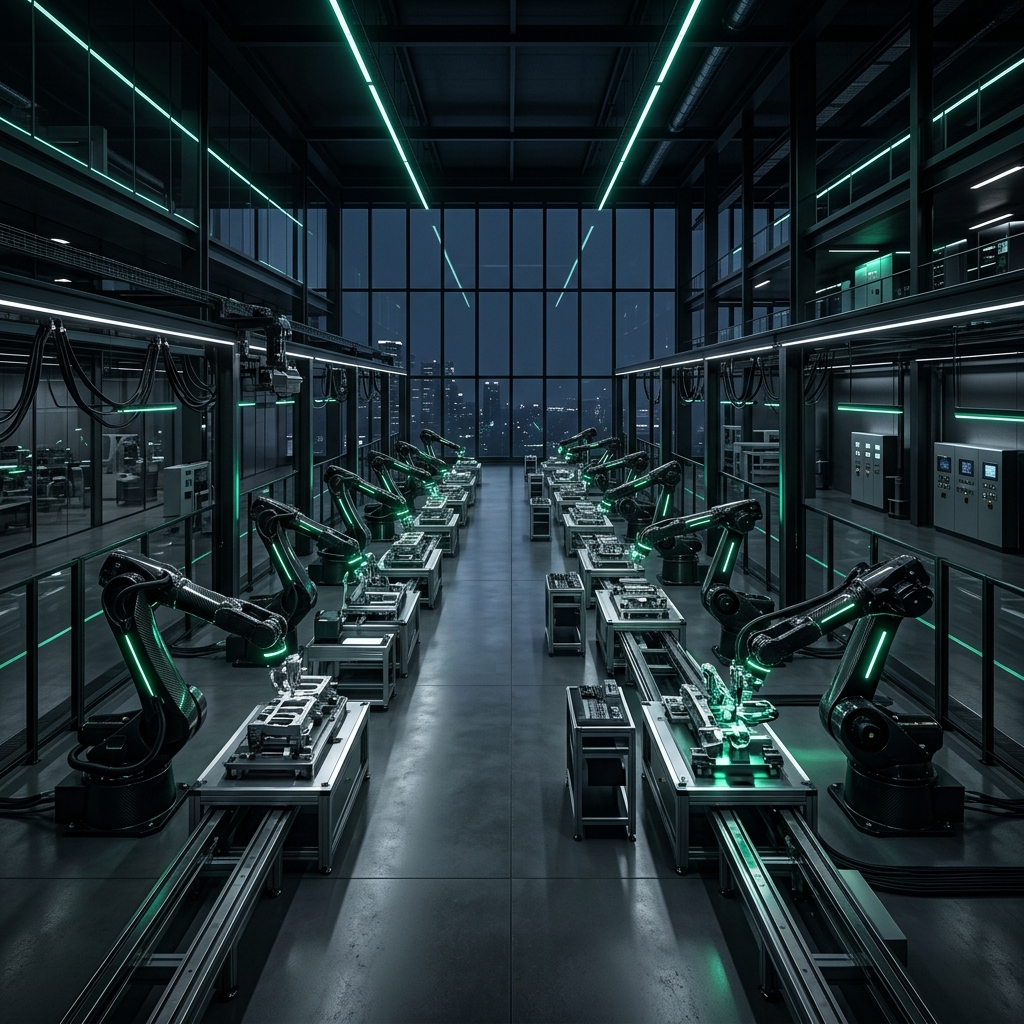
Heavy Industrial Monitoring
"How do we get these alerts into Genetec?" We hear it on every manufacturing call. DHI runs on your existing plant cameras and delivers PPE violations, restricted-zone breaches, and person-down events as native ONVIF metadata, landing in your Milestone or Genetec alarm workflow in under 150 milliseconds.
Deployment Context
Heavy Industrial Monitoring requires environment fit and immediate proof of value.
Verify how DHI integrates with your specific camera estate and VMS workflow before any on-site deployment happens.
Incident Latency
PPE, restricted-zone, and person-down alerts fire on the node in under 150 milliseconds, fast enough to halt a process before harm reaches a worker.
Camera Estate
DHI runs on the plant IP cameras you already operate over ONVIF, so monitoring extends across the floor without new sensor hardware.
VMS Workflow
Violations arrive as standard ONVIF metadata and surface as custom alarms inside Milestone and Genetec, so operators act in the VMS they already run.
Data Sovereignty
Raw plant footage never leaves the site network. Only safety metadata moves between nodes, keeping the deployment air-gapped from the public internet.
Operator Fit
We confirm camera coverage, zone geometry, and alarm routing into your VMS up front, so you know how DHI behaves on your floor before any rollout.
Direct answer
Where does DHI fit inside a manufacturing safety program?
DHI fits where existing plant cameras can become a real-time safety layer: PPE zones, restricted machine areas, person-down zones, loading interfaces, and other places where a visual event needs an immediate operator response.
Zone-specific detection
Manufacturing deployments should start with a mapped hazard zone, not a generic camera rollout. The model, alert threshold, and response path should match the specific floor risk.
Machine-area fit
Restricted-zone alerts are most useful near robotics cells, conveyors, automated doors, and production areas where a person entering the wrong zone creates immediate risk.
VMS continuity
DHI should add safety events to the existing VMS or control-room workflow so operators keep the system of record they already use.
Pilot proof
The pilot should measure event accuracy, nuisance alerts, time to acknowledgement, and whether supervisors received enough location context to act.
Pilot assumptions to validate
- Hazard zones are mapped before model tuning begins.
- Plant leadership agrees which events deserve an alarm and which should only be logged.
- The VMS or response workflow can show the camera, zone, timestamp, and event type quickly.
Plant floor risk
Manufacturing safety breaks down when hazards are visible but nobody is watching the right feed.
Plant cameras already see many of the events that matter: a worker stepping into a robot cell, a blocked aisle near a conveyor, a missing vest in a controlled zone, or a person down behind equipment. DHI turns those existing views into site-specific safety events without forcing operators into another passive monitoring queue.
Zones change by line and shift
A useful deployment has to respect the way each production line actually runs, including maintenance windows, changeovers, temporary barriers, and contractor access.
Generic motion is not enough
Manufacturing alerts need object context, zone geometry, and event type. A person at a marked walkway is different from a person inside a robot envelope.
Supervisors need proof, not noise
The pilot should create searchable event records by line, zone, shift, and incident class so safety teams can see what is repeatable.
High-risk zones
Where the first pilot should prove value.
Robot cells
Where a person crossing a safety boundary should trigger a fast, local alert.
Conveyor pinch points
Where falls, reach-ins, and unsafe proximity can be hard to spot from a control room.
PPE-controlled zones
Where hard hats, vests, eyewear, or other required gear need consistent visual checks.
Maintenance access points
Where temporary work, lockout routines, and contractor movement create changing risk.
Loading interfaces
Where forklifts, trailers, pedestrians, and production flow intersect.
Low-visibility equipment areas
Where a person-down event may not be discovered quickly by normal floor traffic.
Edge AI Capabilities
Neural models operating natively on the NVIDIA Jetson platform, delivering real-time safety signals without cloud dependency.
PPE Compliance Verification
Confirm hard hats, vests, and goggles are worn in designated areas and stream every violation into Genetec as a custom alarm the moment it happens.
Restricted-Zone Monitoring
Alert operators the instant personnel cross into hazardous or automated machinery zones, before a person and a moving asset occupy the same space.
Person-Down Detection
Flag a worker who collapses or falls and trigger medical response protocols immediately, even in areas no one is actively watching.
Deployment model
Start with one hazard map, one alarm path, and one line owner.
A manufacturing pilot should be scoped around the plant floor reality instead of a generic camera rollout. The first deployment needs a clear zone, an event definition, and a response owner who can judge whether the alert changed the shift.
Map the hazard zone
Mark the camera view, restricted area, walkway, machine boundary, and expected human movement before tuning any model.
Set alert severity
Decide which events interrupt the VMS operator, which route to a supervisor, and which are logged for safety review.
Review by shift
Compare alerts across production shifts, maintenance windows, and line changeovers so the deployment reflects real operating conditions.
Pilot KPIs
Metrics a safety team can defend.
Plant teams need alerts that name the physical location clearly enough for a supervisor to act.
A manufacturing safety system fails when operators learn that alarms usually do not matter.
A PPE alert, a restricted-zone entry, and a person-down event usually need different responses.
Edge Integrity & VMS Native Integration
DHI transforms existing IP cameras into intelligent safety sensors. We deliver alerts natively into Milestone and Genetec, requiring zero additional cloud bandwidth.
NVIDIA Jetson AGX
Localized compute executes complex skeletal and object models at the source. Eliminate the cost and latency of cloud streaming.
Native Alert Protocol
Events stream as standard ONVIF metadata. Operators receive alerts in their existing dashboards without learning new software.
Air-Gapped Privacy
Raw CCTV footage never touches the public internet. Only safety metadata leaves the node, maintaining perfect data sovereignty.
Continue Exploring
How person-down detection works
The skeletal modeling behind rapid collapse and fall detection.
Warehouse & logistics safety AI
Forklift, fire, and near-miss intelligence for docks and aisles.
Why factories process video on-premises
The latency and sovereignty case for edge over cloud safety AI.
Edge AI vs traditional VMS motion alerts
How object-aware detection cuts the false alarms motion zones generate.
Deploy a heavy industrial monitoring pilot.
Review supported cameras, VMS alert routing, and the specific measurable KPIs for your industrial & manufacturing safety ai environment.
Scale from 1 location to 100+ with zero cloud architectural changes.
Request a demo
See the flow on a real operating scenario and scope a pilot around one facility or corridor.
See deployment architecture
Review camera ingest, edge inference, alert routing, and what stays on-premises.
Get the implementation checklist
Download the deployment checklist buyers use before green-lighting an industrial AI pilot.
Talk to an engineer
Bring camera count, VMS constraints, latency expectations, and privacy requirements to a technical review.